






















The following article is an opinion piece, and those opinions expressed are those of the authors not of the Peters Township School District.
According to a recent study conducted by Harvard University, 85% of undergraduate students are using artificial intelligence on coursework and homework, and at least 50% rely solely on it for assignments involving any form of writing. Videos on social media are circulating of medical and law students using ChatGPT in class to complete quizzes and assignments for them. How are the future doctors and lawyers of America going to be able to do their jobs efficiently and effectively if they cheated their way through college?
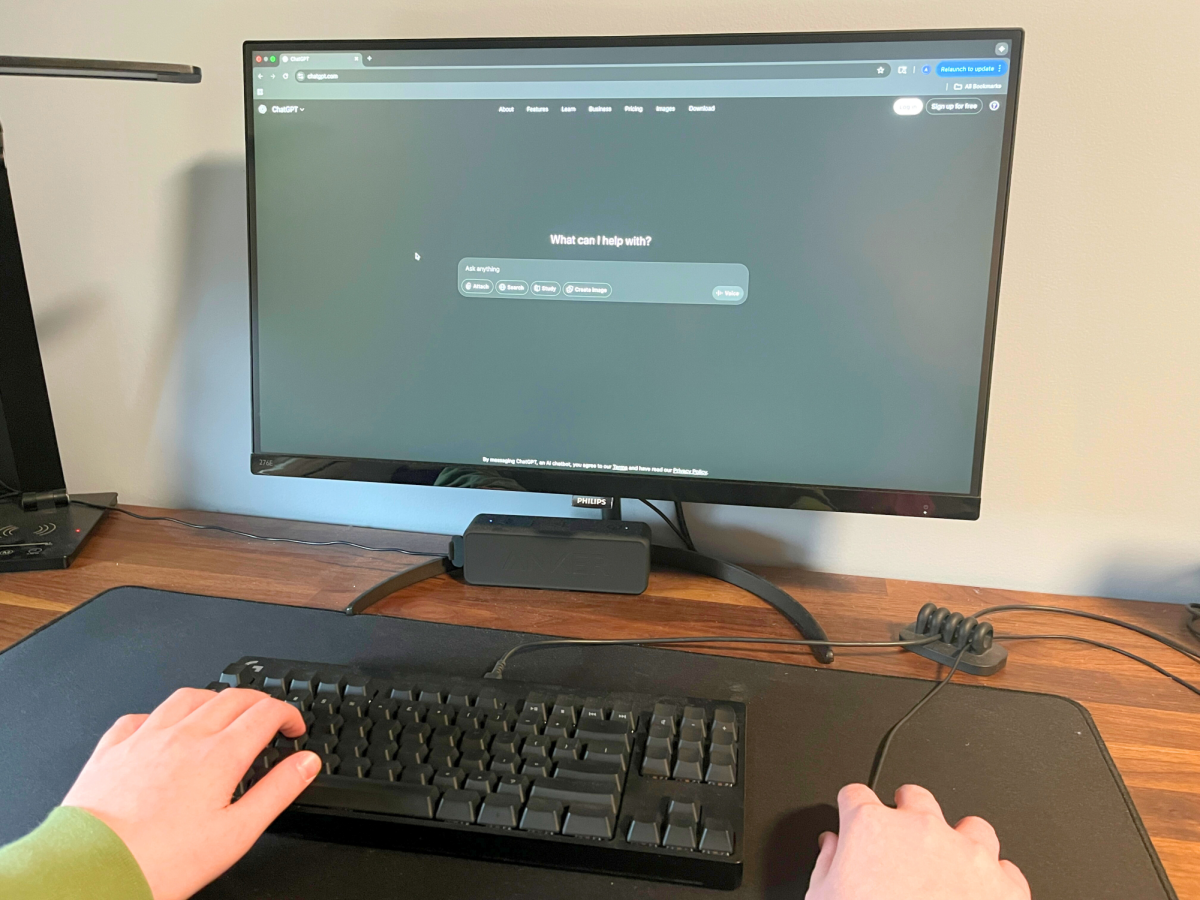
Automatic text generators like ChatGPT, Microsoft Copilot, and Google Gemini are diminishing and discouraging key skills such as critical thinking, grit, and the ability to read skillfully and proficiently. Teachers and college professors continually try to promote these skills in order to foster intellect and independence. Educators teach students how to locate, evaluate, and use information effectively, but if AI tools become the primary source for answers, users are bypassing the process of critical evaluation. These skills are becoming devalued and outsourced by AI, and it is undermining a core aspect of humanity all while students’ literacy rates are suffering tremendously.
Robert W. Gehl, Ontario research department chair of digital governance for social justice at York University, argues that using a chatbot to complete assignments is akin to using steroids to lift weights. This analogy is incredibly valuable and important for students as well as generative AI users to understand because it points out the enduring, negative effects of constantly using automatic text generators. Using steroids allows one to lift weight easier and more quickly and often, and the consequences of using steroids are identical to relying too heavily on artificial intelligence. Long term steroid use can harm one’s body, similar to how constantly outsourcing your assignments to artificial intelligence results in no cognitive gain, and maybe even a cognitive decline. Students are just getting more senseless and inarticulate.
Additionally, the recent decline in literacy rates and the rise of artificial intelligence can be no coincidence; the two go hand in hand. As more and more people use AI to do work for them in an educational setting, students’ ability to understand prompts and think critically is diminishing at record speeds.
Based on the NAEP, or the Nation’s Report Card, which is the largest measure of American student’s abilities in core subjects such as reading, math, and science, data released in late 2025 shows that United States high school seniors average reading scores have hit an all time low since 1992, continuing the trend that students are struggling in basic reading and literacy proficiency.
When students consistently outsource thinking and writing, their comprehension and analytical abilities weaken. When AI becomes a shortcut for answers, it undermines foundational skills teachers constantly try to foster. They encourage curiosity, perseverance, and independent thought, yet these values are unappreciated when text generators replace intellectual struggle. If information is increasingly generated rather than understood, students no longer practice interpreting prompts or synthesizing ideas; instead, they accept prepackaged responses, and their intellect suffers as a result. The declining literacy rate is just encouraging the use of AI. Students use AI, literacy suffers as a result, and students are not able to understand information and assignments, which makes them rely on AI to do their work for them, which in turn repeats and encourages this cycle.
Moreover, artificial intelligence writing is often “perfect” in the sense that it contains no errors and has flawless grammar, but being human is about making and learning from past mistakes. All humans regardless of language, gender, race, and identity make mistakes; it’s part of the universal human experience. Errors are not weaknesses; they are evidence of learning. On top of that, using text generators to write for you eradicates a person’s unique sense of voice and writing style; it strips us of our personality, tone, emotion, and our human attributes. The use of AI is a degradation of human morals and undermines the combined human intelligence.
Learning is genuinely fun when the information one is studying is truly interesting. By outsourcing ones’ work and assignments to a machine, one is eradicating their ability to think for themselves, all because students are too lazy to actually do the work independently. Some students feel the pressure to receive good grades as the reason for elevated AI use, but making mistakes and getting imperfect grades and then overcoming these difficulties is what makes a human a human. Using automatic text generators violates several moral boundaries such as plagiarism, the lack of transparency and authenticity, and the erosion of human autonomy. Furthermore, AI learns from others’ work, so technically, AI generated material is plagiarism, which can result in disciplinary action from academic programs and universities
In essence, generative AI is hindering our ability to think critically, which is a huge part of being able to have adept literary and comprehension skills, and using AI tools discourages tenacity and working through issues. When struggling through a difficult task, people are now more likely to pass on the issue to ChatGPT, and are essentially giving up. The common struggles of life become meaningless, and you do not gain the intelligence that you normally have through the process of hard work over time. Relying on chat bots more than your own brain essentially stunts your intellectual growth.